Sunday, April 19, 2009

The Wolf Issue, Part III


OK, I know this is sort of late. I've been preoccupied with other things and trying to compile my thoughts on this issue so that maybe you'd all get something out of it. I said last time that I'd talk about the positives of having wolves back in the wild. So, along with other things, let's talk about that.

Now, as I've already discussed, hunters are concerned about having wolves back in the wild; about having a predator to compete with. Some of you may have listened to hunters go on and on about how the wolves have or will deplete the elk herds, which wouldn't be right. People talk about how the elk numbers in Yellowstone have dropped significantly since the early 90s, before wolf reintroduction. That is actually true. Elk numbers have dropped by as much as half in certain parts of the park. But this isn't surprising. The elk went more than 60 years without a predator, which made them very comfortable; almost tame. During those 60 + years, the elk numbers actually got out of hand. There were too many elk. There was overgrazing in many areas, which leads to other problems. Elk would eat and trample the plants and grasses which lined stream/river banks, which, in turn led to erosion. Waterways became wider and took new turns. Native plants in those areas nearly went extinct. Where the water ran slow enough, beavers used to build dams and lodges. Once enough erosion occurred and changed the flow patters, beavers eventually became non-existent where before they had thrived. One of the most detrimental things was disease. You see, if the elk numbers become too great, and there's no reason for herds to move or break up into smaller herds, disease becomes rampant, being passed on to the young calves, over and over. For many reasons, it became obvious that something was missing in Yellowstone. The West needed its wolves.

Wolves generally cull the elk populations, by taking out the weak, the sick, or the old. (That's the general pattern--I realize it's not the case 100% of the time.) So, with the wolves in the picture, Yellowstone's elk are healthier. The presence of a supreme predator has caused the elk to change their behavior. No longer do they stay in one place, over populating and over-grazing. The elk now move around. They are much more alert. Native plants are making a comeback along the streams and rivers. Erosion has ceased being the major problem it was. Beavers are back. Fox numbers are up. And the great bio-community is much closer to equilibrium, that balance which is characteristic of a healthy eco-system.

The elk are not gone. They are just more aware of predators, including humans. They don't hang out off the sides of the roads as much. Now the hunters will just have to step their game up and actually hunt, in order to kill. Don't believe me? According to the USFWS, the elk populations of EACH of Idaho, Wyoming, and Montana are a minimum of 14% ABOVE state objectives. So, have wolves decimated elk populations? The simple, irrefutable answer is no.

I realize I've not yet talked much about the social behavior of wolves, especially pack dynamics. That will come in the 4th installment. I'll try to get it up within a week's time.

Here are some websites though, in case you are becoming more and more interested in this topic.

http://fws.gov/mountain-prarie/species/mammals/wolf/

http://westernwolves.org

**The photo above is actually a coyote track, which is half the size of a wolf track, but extremely similar otherwise. It's all I had. And, although wolves and coyotes are closely related, by no means are they the same.

Monday, April 6, 2009

The Wolf Issue, Part II


So, I've now introduced you to the reintroduction of wolves into Yellowstone. I think I want to talk a bit about wolves, their biology, their behavior, and, especially, their social behavior. I want to give you some bits of information, and let you judge, for yourself, whether or not wolves should have a place on the land.

Aldo Leopold did many things during his lifetime but was more notable known as a naturalist/conservationist. (He wasn't always; Do a bit of research and find out what changed his life and his attitude). But I wanted to throw a couple of his quotes in here, quotes with which I think you might agree.

"We abuse land because we regard it as a commodity belonging to us. When we see land as a community to which we belong, we may begin to use it with love and respect." -Aldo Leopold


"A thing is right when it tends to preserve the integrity, stability, and beauty of the biotic community. It is wrong when it tends otherwise." -Aldo Leopold

Now, here are two questions I'd like you to ask yourself and see if you can answer at this point in your life: 1) Are wolves, as a part of nature, helping preserve the integrity, stability, and beauty of the biotic community (the community of all life in the Northern Rockies Recovery Area)? 2) Would allowing or supporting ranchers and hunters to kill off the wolf population in the biotic community, in which they live, help to preserve the integrity, stability, and beauty?

What do we know about wolves and this recovery program?
*Since 1996, the wolf numbers have gone up every year, except this year, when it went down. (So, we began with 66; we now have about 1600).
*In 2008, livestock predation cases numbered 523 for all of Idaho, Montana, and Wyoming. About 245 wolves were LEGALLY killed in those states. (These are the reported numbers. It's expected that there are more killed illegally, which aren't reported).
*The Federal Government, in conjunction with the original reintroduction agreement, and along with other non-profit organizations, compensates ranchers for livestock lost to wolf predation.

So there are conflicts, between wolves and people who don't like wolves, or who do not want them around. That was pretty much a known going into the program. But there have always been efforts to lessen these conflicts, through lethal and non-lethal means. The point is, while there will always be some conflict, we can deal with it, and we can try and make it as fair as possible to all sides. While I want the rancher to be protected as he makes his living, I want tolerance and patience for the existence of wolves.

OK, I'm getting a little fuzzy with where to go from here. (I have a tendency to get off on tangents, regardless of the subject).

Why do ranchers hate wolves? Because wolves eat their livestock. That's the simple answer to it. The complex answer is that they're afraid that wolves will eat all their livestock, even if they've not had any wolf problems yet. And that would be bad for their business. I realize ranching is hard work. I realize that squeezing a buck out of all that work is really hard. But I also think there can be middle ground. I donate to a charity every year that pays into the compensation fund. That's right Mr. Rancher; I want to protect you too. But you have to take some responsibility. You have to assume some risk; That's just part of owning a business. Also, if you summer your animals up in the mountains or on "Free range," you've definitely got to assume some risk. (That's when most predation occurs). You can do things to protect your herds/flocks. Use guard dogs. This is extremely effective. Ride through your herds as often as possible to portray a human presence. (Wolves will avoid humans at almost all costs). OK, here's one of the most innovative things I've heard, but it was done in Europe, not here. Because wolves are fiercely territorial, and are usually pretty staunch about not crossing another pack's boundaries, a sheep rancher put a few loud speakers around his property and played recordings of a pack of wolves' defensive howls, several times a day. It worked like a charm. Zero wolf run-ins. I realize this isn't going to feasible in every case. But put your cowboy hats together. Surely you can come up with something.

Hunters. Oh the hunters. They should call most of you opportunistic killers of lazy convenience. Why do the hunters hate wolves? (Not all hunters do, I realize.) Because wolves are predators and hunters don't like competing with natural predators for game. Hunters like elk. Wolves like elk. The problem for hunters is that a pack of wolves is the supreme killing machine, and wolves don't have to wait until hunting season, or to see if they "drew a tag." I would dare say, and I'm not very naive on the subject, that MOST hunters do their hunting these days, primarily for a nice trophy to hang on a wall, with which to impress themselves and their peers. The meat is secondary, if used and eaten at all. (How about those trophy hunters going on "Safari" in Africa? Talk about a canned hunt. And they don't get to bring the meat home. What a blood-letting waste.) Wolves kill because they have to. If they don't they die. Face it Mr. Hunter; if a 90lb. wild dog can bring an elk down, it deserves that meal. And driving on the dirt roads in your huge truck or on your ATV, sporting your expensive gear, not the least of which is your high-powered rifle and scope, which you'll use to make that 500 yard shot, IS NOT HUNTING. How do I know? Because I grew up hunting. Anyway, while I can get behind the ranchers a bit, I just cannot conjure up anything sympathy for your plight. Sorry.

I think the hostility toward wolves is rooted in the traditions of hunting and ranching in the West. But I also think a lack of understanding and education is a big factor as well. Most of these anti-wolf people have never seen a wolf in the wild. Many of them cannot tell the difference between wolves and coyotes. Really, I think education about wolves and wolf biology would go a long way in quelling the madness. You many want to pick up another book, or visit some good websites, especially if the last pieces of literature you read were "Little Red Riding Hood," or "The Three Little Pigs."

Hunters will argue that their side should trump mine because of all the money they spend on licenses, permits, tags, and such, some of which ends up in conservation efforts. I think that's great. I too spend money on conservation efforts. I think it's a worthy cause. I'm glad you like to hunt. I just wish more of you did it for meat only. (I think you'd be a little less competitive and angry if you weren't so preoccupied with getting a bigger trophy than your buddies.) I'll add this as well: In Utah, according to the USFWS Survey, for every $1 spent on hunting and fishing, $2 are spent on wildlife watching. So, maybe my side trumps yours? No, remember I believe that we can reach middle ground and have everyone win in some way.

OK. I'll end there. There will be a Part III very soon, which will talk about all of the positives of having wolves back in the Wild West.

***Oh yeah, why did I post a picture of my two dogs? I'll touch more on that next time but, it's because our domesticated pet dogs are the same species as wolves. That's right, if it weren't for wolves, the rancher wouldn't have his heelers, the hunter wouldn't have his hounds, and Paris Hilton wouldn't have her tea cup poodle accessories. OH BROTHER!!!

Friday, April 3, 2009

The wolf issue, through my eyes...


OK, this may be lengthy, as I have plenty to say about this issue and am horrible, sometimes, at compiling my thoughts in an orderly, coherent fashion. I have been passionate about canis lupus (the gray wolf) for about 10 years. In college, whenever it was allowed, I would write my papers on wolves. I really don't know where my interest originated, but I have become more and more involved in this issue; especially that of wolf reintroduction in Yellowstone National Park, and in the Northern Rockies. Anyhow, if you do much looking around, you'll find out that this is a pretty hot-button, contentious issue in the West. The following entry is what I think about the whole thing.

The last known wolf in the western U.S. was shot and killed in about 1930. Where wolves once roamed free, they were now gone. This was not coincidence. It was not simply the wolves' fate. It was done, according to orders by the U.S. government. You see, by this time, there were many sheep and cattle ranches, spread across the land. And, as often, or rare, as it happened, the fact was that wolves were killing sheep and cattle. Why? Well, I have a few ideas. Let's back up a bit. Before the West was settled by these ranchers, wolves had food in plentiful supply: deer, elk, moose, and bison. (Also a lot of mice and squirrels during the summers). Well, bison in particular would feed a wolf pack very well. But bison were nearly killed to extinction as well, in part to starve out the American Indian, and, to make room on the praries for great herds of cattle. Rid the wolves of bison herds and the wolves move onto the next best thing: stupid cows. I like to bring this up to wolf hating ranchers because, it's my opinion that the ranchers sort of perpetuated the problem. To solve the problem back then, the powerful and wealthy ranchers coaxed the government to get rid of the big, bad wolves. And it was done by any means necessary back then; trapping, shooting, poisoning, drowning (pups), etc...

Well, jump ahead to the 70s. People, across the country, began to think differently about wildlife, even predators, which included wolves. Thank God for the hippies. In 1973 the Endangered Species Act was passed. The wolves were soon on it, and the workings of bringing these incredible animals back had begun. It took 20 years or so to make enough progress with changing public opinion, researching environmental impact, and convincing the government that Yellowstone needed wolves in its eco-system. (Wolves actually roamed the entire country at one time, especially the mountainous land from Alaska and Canada, down to Mexico.) In 1996, the first wolves were brought from Canada, mainly British Columbia, to Yellowstone National Park. The reintroduction of wolves into their once native territory was happening.

Now for some wolf biology. Wolves have something in them, much like a homing device. Take them to Yellowstone and drop them off, they'll find their way back to Canada in a matter of days. They travel, even within their own territories, an average of 25 miles daily. They do this with ease, being natural-born athletes, with very strong lungs, and long legs. Because of these things, when the wolves were transported to Yellowstone, they were placed with their families, in acre-sized holding pens, and kept there for 10 weeks. There were 3 pens total, placed in 3 different areas of the park. They were called acclimation pens. And they were successful; After 10 weeks, the wolves had forgotten about Canada and now claimed these areas as home. A total of 66 wolves were brought into the park. Just over 12 years later, there are an estimated 1500-1600 wolves within the Northern Rockies Recovery area, which includes parts of Montana, Idaho, Wyoming, and a small chunk of Northern Utah. The recovery has been successful thus far.

When the government agreed to this project, the plan was to get a certain number of packs established, and then to turn the management over to the affected states. A little over a year ago, the Bush Administration delisted wolves from the Federal Endangered Species list. Quickly, conservation groups sued the feds to relist wolves, arguing that all of the objectives of the project had not been met. A judge ruled and wolves were relisted. Just before Bush left office, he delisted wolves again, a decision which was upheld about a week ago by our current Secretary of the Interior. However, the fight will go on and, I'm sure, the wolves will be re-relisted soon. The biggest problem with taking federal protections away now is that one really important thing hasn't happened enough. Because the packs have moved around, and their boundaries are now separated by highways, housing developments, urban sprawl, etc...the gene pools are not mixing. But, I'm not sure how that will ever happen now. It's not like those developments and highways are going away. In reality, there will be those who will never want wolves delisted. Biologists, on the other hand, want the states to manage the wolves. This would be more likely if Wyoming were to change their position and their managment plan, which, currently, is to list wolves as vermin, where they can be shot on site at any time, for any reason, in 90% of the state. Not going to happen Wyoming. Well, that's how the reintroduction program has gone thus far.

I think I'm going to present this stuff in a few parts. It's just getting to long and no one likes to read long post. So, I'll do it in a few shorter entries. But if you read this, and you have any comments or questions, please leave them and it will spark a better discussion and more thoughts in my mind for the coming entries.

P.S. That photo is from a book I own, called "The Wolves of Yellowstone." That is "Male #10,"--one of the original 66. His genes are everywhere in the Northern Rockies recovery area now. Incidentally, none of the 66 are still alive.

Sunday, March 29, 2009

Leftovers...


I've cleaned out my memory cards. The following are the leftovers. Just random things from photography class. Enjoy. Or don't. I really don't care.

1) The river on its way out to Utah Lake.

2) Professor Jami.

3) Marie. Life of the party.

4) Baby on a box.

5) Baby in a basket.

P.S. These were all taken with that little Casio point and shoot that I brought to class all those times. Probably would have done a better job with my new camera. Oh well.

Spring Storm '09. A treat for the dogs.


Just wanted to post these photos. I took them today after the sky threw down about 4 inches of snow. It always puts a little spring in my dogs' steps. And, since I haven't taken any pictures of Jake and Puka for awhile, I thought today was the perfect opportunity.

Puka is our 4 year old Siberian Husky/wolf female. While I would never promote wolf/dog breeding, we wanted to give Puka a better home than she previously had. And we love her. She's so pretty. We especially love her icy blue eyes, which are a little tough to capture, given her wiggly, high-strung temperment.

Jake is our 10 year old Alaskan Malamute. I've had him since he was a pup and we have been best friends ever since. He's a terrific pet.

It took these two over a year to accept each other, but they have and are quite the pair. Incidentally, they were quick to accept our son, Jericho, as the newest pack member. I'd love to do an entire family portrait. But that's really going to take some work and more patience than I have to spare right now.

Jami's photography workshop '09...


I've forever been interested in photography and, recently, I signed up for and attended a photography workshop. It was given by a good friend of ours, Jami Broadbent. She's the pretty girl holding the flower. (She was helping me learn to use the focus points on my camera.) I've known Jami for over 10 years, having met her through one of my longtime friends, Mr. Jarin Broadbent, Emeritus Champion Elvis impersonator and 1st chair percussionist, 8th grade band. He's the classy guy with the polka-dot phone in hand. Anyway, these are two of the best people I know, and it's been fun having Jami teach me the art of portrait photography. (Mind you, she is one of the best photographers around, seriously.)

Her course was six weeks long and I learned a lot. The class was interesting from the beginning. When I arrived for the first class, I found myself to be the only guy. The other 10 students were all girls. I could also be identified in class as the only one using a point and shoot camera, rather than the fancier, more professional SLRs. Everyone was nice to me about it, and eventually, I got my own SLR. Yeah!!! Best present to myself, ever! (Thank you for letting me get it Honey). Also, eventually, another guy began showing up for class. The testosterone and estrogen see-sawed more toward a balance.

Jami taught us everything we need to know. (Well, to get us started anyway. I keep telling her she needs to do "Jami's Photography Workshop, Volume II.") I now know about apertures, f-stops, ISO, and histograms. I know what someone means when they talk about leading lines, the rule of thirds, and proper subject-framing. I feel so smart. But I also know that there is a ton that I still don't know. And I'm still thousands of dollars away from being properly and sufficiently equipped to do wildlife photography as I'd like. Still, I'm wiser than I was a couple of months ago.

Saturday was our final class. For it, we hung out around the quaint downtown of Payson, UT. We had a model there, a daughter of one of my classmates. (I'm so bad; I've forgotten her name. I want to say Mallory, but I'm unsure). At any rate, she was a great model; made it easy to take decent pictures. I still don't have all the settings just right, but I've posted 3 of, what I feel are, my best pictures.

Hope you all like them. And if you don't, I'll gladly accept your constructive criticism.

Saturday, March 7, 2009

Lions and Tigers and...well....mostly bears...OH MY!!!


Last year at this same time, my boss told me about the possibility of going with him and this biologist friend of his down to track bears in Southeastern Utah. But when it came down to it, there wasn't room for me after he decided to take all of his boy scouts instead. I was bummed to say the least. But this year, he had the same chance to go again and made sure that there was a place for me. No scouts this time. Yeah!!!
So today I woke up at about 5AM so that I could get myself ready to meet Rich (my boss) at the mouth of Spanish Fork Canyon by around 6. My wife worked last night and, since she wouldn't be off until 6AM, she was kind enough to let me drop Jericho off at the ER for the remainder of her shift. So nice to have such a wonderful wife and so glad that dropping Jericho off at the ER is cool with everyone else.
Anyway, I met my boss and we drove about 3 1/2 hours to an area called the Book Cliffs. I sort of had the idea that it was just me and Rich going with Doc Black (the head biologist). When we arrived at the meeting point, there were about 100 other people. No; literally about a hundred other people. I was a little disappointed at first, hoping that I was in for a more intimate encounter with nature and wildlife, but after this experience I am grinning ear to ear.
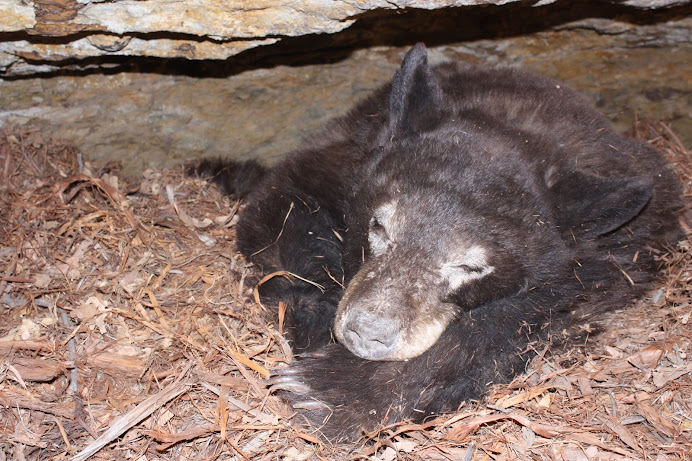
The bear we tracked--by radio collar--was a 24 year old sow. (Black bears have a life expectancy of around 25 years--and this one is still having babies). She has been tracked for many years and was once thought to be a bum mom, never successfully rearing her cubs past the first year. Instead, most of her cubs starved. Anyway, in her sunset years, she has had 2 sets of triplets and had just a single female cub this year. I was sort of hoping for a nice hike but this bear was found only 1/4 mile from the road. As you can imagine, having a 100 people there, of all ages, was a recipe for chaos. Doc Black and his students kept stressing the importance of being quiet and not doing anything that might frighten or alarm the sow or the cub. But a crowd will be a crowd, and it was a bit like the lines for the rides at DisneyLand. We were kept back at the road until the grad students had successfully tranquilized the sow. Then we were told, "OK, now talk in your church voices and we're just going to SLOWLY meander on over to the den; no need to run or get into a hurry." I was immediately taken back to my days as a tour bus driver in Alaska when I'd tell people to, "Be quiet." "Don't run." "Don't feed/touch the animals." This crowd of 100 eager bear lookers moved like an army of hungry ants on their way to devour the day's unlucky victim. I pretty much saw it coming.
Well, when I finally got my turn at the den, I was thrilled to sit down by that magnificent animal. How amazing to think that this stealthy bear has made it 24 years in this area known for some of the most prize hunting in Utah. And here she was, raising another cub, one that will, hopefully, go on to raise her own for years to come. The photo opportunity at this point was over quickly. Once everyone had taken their turns, most everyone took off back to the road and their vehicles. Rich and I stayed behind, watching Doc Black as some BYU students interviewed him on camera. The biology students had pulled the sow back into her den by now, and had placed her cub with her again. And then, to my astonishment, they told us we could crawl back into the den and take pictures in there, since the sedation hadn't yet worn off. "Are you serious?!?!, I asked." And they said it was OK. So we crawled in their on our stomachs, with our cameras and got within about 3 feet of her head to snap some amazing shots. (Funny thing, apparently my new camera's setting was on too large a file size so the pics I've posted were all that will fit here). I'll post everything on facebook.
Anyway, this was such an amazing experience. Those of you who know me well enough, know that I LOVE wildlife, especially seeing it alive. (Not so big on killing things so I can look at the carcass on my walls). I really hope this will turn into something I can do a few more times in the future.